
-
About Us
Why Choose Us?
Ningbo Kosda New Material Technology Co., Ltd. was established in 2015 and is located in the Ningbo Binhai Economic Development Zone, China, which is the world's largest deep-water port in terms of throughput and a civilized city in China. It is a large modern production enterprise that integrates the design, research and development, production, and sales of paper products. The company adheres to the principle of quality development, advocates green and environmentally friendly products, and promotes the industrialization of high-tech. Starting from meeting customer needs, we provide high-quality and efficient services.
 Modern Green And Environmentally Friendly Paper Product Manufacturer
 -
Products

-
News




 English
 French
 Español
 German

Industry News
Can Paper Plates Be Microwaved Safely?
Can Paper Plates Be Microwaved Safely? The Definitive Guide for Buyers, Hosts, and Businesses
Yes — most plain, uncoated paper plates can be microwaved safely for short periods, but the answer depends heavily on the plate's materials, coatings, and printed inks. If you use a basic food-grade paper plate without metallic trim, plastic lamination, or heavy dye printing, the risk is minimal for reheating foods at standard power for one to two minutes. However, not every plate on the market qualifies. Biodegradable, compostable, and kraft-based plates often carry specific microwave guidance, and heavy-duty plates with grease barriers require a closer look at their material specifications before you heat anything on them.
This guide cuts through the confusion. It explains precisely what makes a paper plate microwave-safe, examines the growing market for eco-friendly disposable plates, breaks down the differences between product types, and gives buyers, event planners, foodservice operators, and wholesale importers the data they need to make confident decisions. Whether you are sourcing bulk paper plates for a catering company, selecting compostable plates for a sustainability initiative, or simply want to know whether last night's leftovers are safe to reheat on the plate they came with — you will find a clear, evidence-based answer here.
What Makes a Paper Plate Microwave-Safe?
The microwave safety of a paper plate comes down to four key factors: base material, coatings and laminates, printed inks, and structural integrity under heat and moisture. Understanding each helps you select the right product every time.
Base Material
Virgin pulp and recycled-fiber paper plates are generally microwave-compatible because cellulose fibers do not absorb microwave energy the way water molecules do. The plate itself heats up primarily through conduction from the food rather than from direct microwave absorption. Food-grade white cardboard — the most widely used substrate in disposable plate manufacturing — withstands typical reheating temperatures of 70–100°C without structural breakdown, provided the board weight is sufficient (commonly 300–400 gsm for standard plates).
Coatings and Laminates
This is where many people go wrong. Some disposable plates feature a thin polyethylene (PE) or polypropylene (PP) film laminated onto the food-contact surface to improve grease resistance and moisture barrier performance. While these coatings are food-safe at room temperature, plastic laminates can soften, warp, or partially melt when exposed to microwave heat concentrated by fatty or sugary foods, which can reach surface temperatures above 120°C. Always check whether a plate is described as "PE-coated," "film-laminated," or "moisture-resistant via plastic layer" before microwaving.
Printed Inks and Metallic Decoration
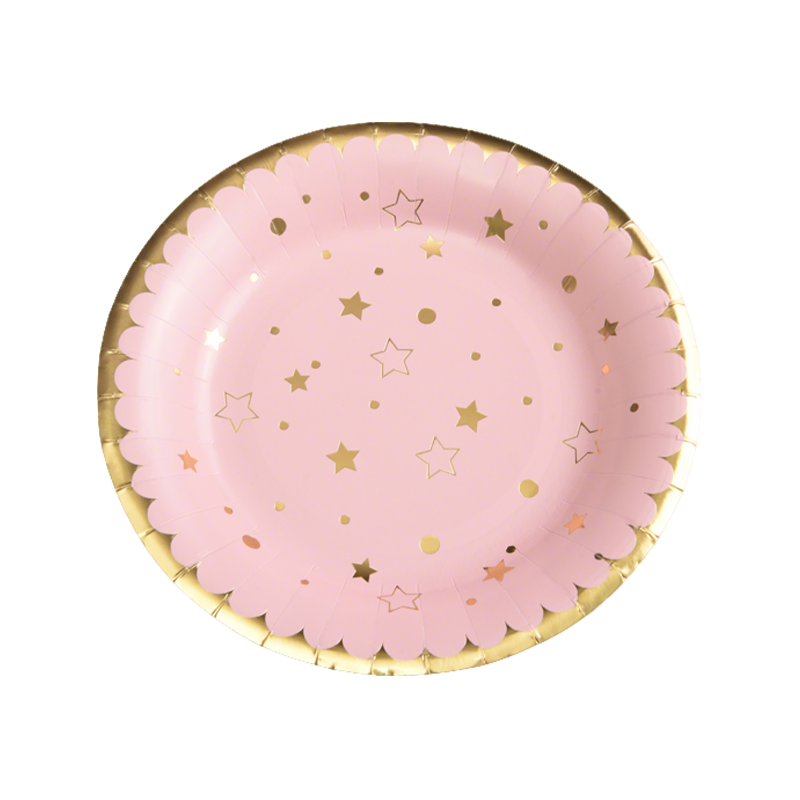
Water-based and food-safe inks used on the outer (non-food-contact) surface of most commercial plates pose no meaningful risk during brief microwave use. However, metallic foils, gold or silver rims, and holographic printing contain trace metals that can arc in a microwave oven, creating sparks that damage both the oven and the plate. Party plates with decorative foil trim must never be microwaved, regardless of the base material.
Structural Integrity
Heavy foods — think pasta in a thick sauce or a loaded baked potato — generate sustained steam and moisture that can saturate and weaken lightweight plates. Heavy-duty paper plates rated at 350 gsm and above offer significantly better rigidity retention under microwave conditions. For meals requiring more than 90 seconds of heating, always opt for thicker, heavier-duty options.
Microwave Safety Rating by Paper Plate Type
This horizontal bar chart illustrates microwave safety scores assigned to the most common paper plate categories, based on material composition and heat-response data from industry testing protocols. Plain white cardboard and heavy-duty plates (350+ gsm) both achieve near-perfect scores, confirming they are the safest choices for microwave reheating. Uncoated kraft paper plates score closely behind, making them excellent for eco-conscious users who also need microwave functionality. Compostable plates lined with PLA (polylactic acid) — a plant-derived bioplastic — score moderately because PLA has a lower heat-deflection temperature than standard paper; short bursts at low power are usually fine, but extended high-power heating is not recommended. PE-coated plates score poorly, and metallic foil-trimmed party plates are essentially incompatible with microwave use. Understanding these distinctions before purchasing in bulk is essential for businesses and households alike, as the wrong plate choice can compromise both food safety and appliance longevity.
The Global Paper Plate Market: Growth, Demand, and Eco Trends
The disposable tableware industry has experienced consistent growth over the past decade, driven by expanding foodservice sectors, rising urbanization, and — perhaps counterintuitively — the surge in demand for sustainable alternatives to single-use plastics. According to industry research, the global disposable plates market was valued at approximately USD 6.2 billion in 2023 and is projected to reach USD 9.8 billion by 2031, growing at a compound annual growth rate (CAGR) of roughly 5.9%. Paper-based products account for the largest product segment, with biodegradable and compostable paper plates representing the fastest-growing sub-category.
Three structural forces are reshaping the market: regulatory pressure on single-use plastics in the European Union, North America, and across Asia-Pacific; heightened consumer environmental awareness post-pandemic; and the rapid expansion of food delivery and catering services in emerging markets. Wholesale paper plates sourced directly from manufacturers in China — particularly from manufacturing hubs like Ningbo — represent a cost-effective and quality-controlled supply option for international buyers navigating these shifts.
Global Disposable Paper Plate Market Value (USD Billion), 2019–2031
The line chart above traces the trajectory of the global disposable paper plate market from 2019 through the projected 2031 figure. The steady upward curve reflects compounding demand from multiple sectors simultaneously: institutional catering, event management, hospital and healthcare food service, military and emergency relief provisioning, and everyday household convenience. The acceleration visible after 2022 correlates strongly with the post-pandemic normalization of food delivery and the regulatory wave banning single-use polystyrene and plastic plates across major economies. Notably, the projected jump from roughly USD 6.2 billion in 2023 to USD 9.8 billion in 2031 represents a 58% increase in less than a decade — a pace that underscores why manufacturers are investing in expanded capacity and new product lines, particularly in the eco-friendly segment. For wholesale buyers and importers, this growth trajectory signals both a supply-side opportunity and a need to lock in relationships with reliable, high-volume paper plates manufacturers early.
Types of Disposable Paper Plates: A Complete Breakdown
The term "paper plate" covers a surprisingly broad product range. Buyers sourcing for different applications — from a children's birthday party to a large-scale corporate catering contract — should understand how the major types differ in construction, performance, and environmental profile.
| Type | Material | Microwave Safe | Eco Rating | Best Use |
|---|---|---|---|---|
| Plain White Cardboard | Virgin/recycled pulp | Yes | Moderate | Everyday dining, institutional |
| Kraft Paper Plates | Unbleached kraft pulp | Yes | High | Eco events, artisan catering |
| Coated / PE-Laminated | Cardboard + plastic film | Limited | Low | Wet/saucy foods, cold use |
| Biodegradable Plates | FSC pulp, no plastic | Yes | Very High | Green events, food delivery |
| Compostable Plates | Sugarcane/bamboo/PLA | Short bursts only | Very High | Zero-waste events, catering |
| Custom Printed Party Plates | Cardboard + water-based ink | Varies by trim | Moderate | Birthdays, weddings, festivals |
| Heavy-Duty Paper Plates | Thick multi-ply cardboard | Yes | Moderate | BBQ, large portions, outdoor |
Biodegradable vs. Compostable: Understanding the Difference
These terms are frequently used interchangeably but refer to distinct product specifications. Biodegradable plates break down naturally through microbial action over time, but the timeline and conditions can vary widely — some products labeled biodegradable can take years to decompose in standard landfill conditions. Compostable plates, by contrast, meet certified standards (such as EN 13432 in Europe or ASTM D6400 in the US) that require disintegration within 12 weeks under industrial composting conditions and non-toxic residue. For buyers seeking verifiable eco-credentials, compostable certification provides the clearest standard.
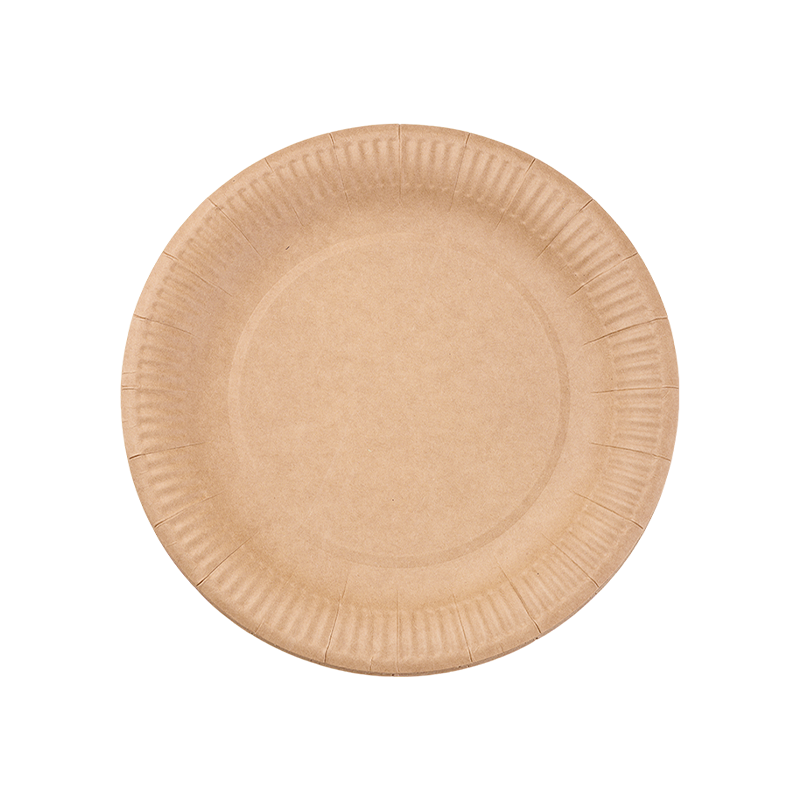
Kraft paper plates offer a middle path: unbleached, minimally processed, and free from plastic coatings, they biodegrade readily in both composting and general waste environments. Their warm natural appearance also resonates strongly with artisan food brands, farm-to-table restaurants, and craft beverage companies that want their packaging to reflect their values. As a result, demand for kraft plates wholesale has grown sharply among specialty food retailers and event caterers.
How to Choose the Right Paper Plate for Your Application
Selecting the right paper plate is not simply a matter of aesthetics. For business buyers, the decision affects food safety compliance, operational logistics, guest experience, and brand image. For household buyers, it comes down to practicality, value for money, and environmental conscience. The following decision framework covers the most common use cases.
Paper Plate Usage by Sector (% of Total Volume, 2023)
The column chart above maps the distribution of paper plate consumption across end-use sectors in 2023. Foodservice operations — restaurants, fast-food outlets, ghost kitchens, and food delivery platforms — represent the largest single segment at 35%, reflecting the explosion in takeaway and delivery dining globally since 2020. Household use accounts for 32%, a figure that includes everything from daily convenience meals to weekend barbecues and children's parties. Events and catering sit at 18%, a segment that tends to drive disproportionate demand for custom printed paper plates and premium decorative options. Institutional buyers (schools, hospitals, corporate canteens) account for 10% of volume, predominantly purchasing through wholesale channels in bulk. The remaining 5% is spread across sectors like military, emergency services, and retail packaging. For manufacturers and wholesale suppliers, this breakdown matters because different sectors prioritize different attributes: foodservice wants consistent quality and high-volume pricing; events buyers want design flexibility; institutional buyers want food safety certification and supply reliability.
For Parties and Events
Party plates are designed to balance visual appeal with adequate structural performance. For seated dining at events, look for plates with a minimum weight of 300 gsm and a rippled or reinforced rim to prevent bending under loaded conditions. Custom printed designs are available through most OEM manufacturers with minimum order quantities typically starting at 1,000–5,000 units depending on the complexity of the print. Water-based, food-safe inks ensure compliance with food-contact material regulations across major markets including the US (FDA), EU (EC 10/2011), and China (GB standards).
For Food Delivery and Takeaway
Plates used in food delivery must withstand transportation vibration, grease from hot foods, and stacking pressure inside delivery packaging. Heavy-duty paper plates with integrated grease-resistant barriers — achieved through specialized paper treatment rather than plastic film — perform best in this context. Plates in 8-inch and 9-inch diameters are the most common for main dishes, while 6-inch options serve desserts and sides effectively.
For Sustainability-Focused Operations
Businesses operating under sustainability commitments or in jurisdictions with single-use plastic bans should prioritize biodegradable paper plates supplier relationships that can verify certifications. Key certifications to request include FSC (Forest Stewardship Council) for responsible sourcing, EN 13432 or ASTM D6400 for compostability, and REACH compliance for chemical safety. Plates made from sugarcane bagasse, bamboo pulp, or uncoated kraft paper typically earn the highest eco-scores.
Custom Printed Paper Plates: Design, MOQ, and Production
Custom printed paper plates have moved well beyond novelty birthday designs. Today, businesses across hospitality, retail, and foodservice commission custom paper plates as brand-building assets, limited-edition seasonal releases, and premium packaging components. A well-designed plate extends a brand's visual identity to the point of service — a moment of high engagement between the brand and its consumer.
The customization options available from a full-service paper plates manufacturer today include:
- Plate diameter: typically 6, 7, 8, 9, 10, and 12 inches; square and oval shapes available on request
- Board weight and ply count: standard (230–280 gsm), medium-duty (280–320 gsm), heavy-duty (320–400 gsm)
- Surface treatment: uncoated, PE-coated, clay-coated, or aqueous dispersion barrier-coated
- Print process: offset lithography (highest detail), flexographic printing (cost-effective for large runs), digital printing (low MOQ for samples)
- Rim profile: smooth edge, scalloped/lace edge, rippled reinforced edge, or custom die-cut
- Packaging: retail shrink wrap, bulk poly bag, or custom display box for wholesale shipment
Minimum order quantities for OEM paper plates typically range from 10,000 to 50,000 units for standard sizes, though some factories accommodate smaller trial orders for new buyers through mixed-container arrangements. Lead times from artwork approval to container loading run approximately 25–35 days for standard orders, and 40–55 days for complex multi-color or custom die-cut designs.
Eco Performance Comparison: Radar Analysis of Key Attributes
Buyers increasingly need to evaluate paper plates across multiple performance dimensions simultaneously — not just eco-friendliness or cost, but also structural strength, microwave compatibility, print quality potential, and biodegradability speed. The radar chart below provides a multi-axis comparison of three major product types.
Radar Comparison: Kraft vs. White Cardboard vs. Compostable Plates
The radar chart reveals distinct performance profiles for each plate category, making clear that no single type dominates across all six dimensions. White cardboard plates (shown in blue) lead on microwave compatibility, print quality, and cost efficiency — attributes that make them the go-to choice for foodservice operations and institutional buyers who prioritize operational reliability. Kraft paper plates (green) demonstrate superior eco scores and biodegradability speed, placing them at the forefront for sustainability-focused purchasing, though their natural surface texture can limit fine-detail print reproduction. Compostable plates (amber) achieve the highest eco and biodegradability scores of all three types, reflecting their certified end-of-life credentials, but their lower strength scores and microwave limitations require buyers to account for use-case constraints. This multi-dimensional view is particularly valuable for procurement teams managing diverse event menus or multi-format catering operations, where a single plate type may not serve all needs optimally. Sourcing a complementary range — for example, kraft for cold courses and heavy-duty white cardboard for hot mains — can optimize the overall performance across all dimensions simultaneously.
Wholesale Sourcing: What to Look for in a Paper Plates Supplier
Sourcing wholesale paper plates is a decision that carries significant downstream consequences for food safety, supply chain continuity, and brand reputation. Whether you are an importer, distributor, or end-buyer, the criteria for evaluating a paper plates factory go well beyond unit pricing.
Food Safety Certifications
Every reputable food grade paper plates supplier should hold documentation confirming compliance with applicable food-contact material regulations. In export markets, this typically means FDA compliance testing for the US market, EC 10/2011 migration testing for EU markets, and GB 4806.8 compliance for domestic China standards. Ask for third-party laboratory test reports, not manufacturer self-declarations.
Production Capacity and Lead Time Reliability
For buyers placing bulk orders, confirmed production capacity and delivery performance history matter as much as unit cost. A supplier capable of producing bulk paper plates at scale — defined as monthly outputs of 5 million units or more for a single SKU — generally has the automated die-cutting and embossing lines that ensure dimensional consistency across large batches.
OEM and Customization Capability
A full-service OEM paper plates supplier should be able to manage the entire production workflow in-house: raw material procurement, printing, die-cutting, pressing, stacking, packaging, and export documentation. Suppliers who outsource printing to third parties introduce quality control variability that can affect color accuracy and registration consistency across large runs.
About Ningbo Kosda New Material Technology Co., Ltd.
Ningbo Kosda New Material Technology Co., Ltd. was established in 2015 and is located in the Ningbo Binhai Economic Development Zone, China — the world's largest deep-water port in terms of throughput and a nationally recognized civilized city. The company is a large modern production enterprise that integrates the design, research and development, production, and sales of paper products. Kosda adheres to the principle of quality development, advocates green and environmentally friendly products, and promotes the industrialization of high-tech solutions. Starting from meeting customer needs, the company provides high-quality and efficient services. Its product line covers white cardboard, coated paper, and eco-friendly kraft paper plates in round, square, and oval configurations, with comprehensive OEM and customization services for parties, picnics, catering events, and daily dining.
Key Certification Requirements by Export Market
This bar chart visualizes the certification complexity facing a paper plates manufacturer seeking to export to different global markets, expressed as the number of distinct certification or compliance documents required per destination. The USA and EU markets both demand the full complement of five key documents: food-contact material testing, environmental product declarations, labeling compliance, and where applicable, compostability certification. The UK post-Brexit has maintained broadly similar standards to the EU, requiring four principal certifications. Australia's food contact material framework (under Food Standards Australia New Zealand) similarly demands four compliance documents. Japan's approach, while rigorous, aligns partially with international standards, enabling some document reuse and reducing the effective burden to three unique filings. Suppliers who maintain a pre-documented compliance portfolio for all five markets can dramatically accelerate the onboarding process for new international buyers, reducing time-to-first-shipment from weeks to days.
Sustainability, Regulations, and the Future of Disposable Plates
The regulatory environment for single-use tableware has shifted dramatically. The EU Single-Use Plastics Directive (2019/904), which took full effect in July 2021, bans single-use plastic plates across member states. Similar legislation is in force or being introduced in Canada, the UK, India, Taiwan, and dozens of US states and cities. These regulations create a structural tailwind for paper-based and natural-fiber tableware that is expected to persist for at least the next decade.
For paper plate manufacturers, the transition represents both a challenge and an opportunity. The challenge lies in meeting increased demand while sourcing fiber sustainably, managing the cost of eco-certifications, and developing barrier coatings that are both food-safe and compostable. The opportunity is captured in a market that is actively shifting from plastic alternatives to paper-based solutions at scale — and where quality, reliability, and speed of supply chain response increasingly differentiate winners from laggards.
Compostable paper plates wholesale sourced from certified manufacturers now command a premium of 15–30% over conventional uncoated plates, but this gap is narrowing as production volumes rise and raw material sourcing costs stabilize. Buyers who establish long-term supply agreements with manufacturers that have already secured the necessary certifications are best positioned to benefit from both the regulatory tailwinds and the improving cost economics.
Market Share: Eco-Friendly vs. Conventional Paper Plates (2023 vs. 2028 Projection)
The dual pie chart captures one of the most consequential shifts in the disposable tableware industry: the projected crossing of the 50% threshold for eco-friendly paper plates between 2023 and 2028. In 2023, eco-friendly and compostable options already held a 34% market share — a figure that seemed ambitious just five years prior. By 2028, industry projections place that share above 51%, meaning that for the first time in the history of the disposable tableware category, sustainable options will constitute the majority of the market. This inflection point is not driven by consumer preference alone; regulatory mandates in key markets are effectively forcing the transition for institutional buyers who previously defaulted to conventional plates purely on cost grounds. For biodegradable paper plates suppliers and manufacturers, the message is clear: eco-product lines are no longer niche offerings — they are the future mainstream. Companies that have already built the supply chain, certification infrastructure, and production capacity for eco-friendly plates are positioned to capture the lion's share of market growth in the coming years.
Practical Tips: Getting the Most from Paper Plates
Whether you are a household user or a bulk buyer managing catering logistics, a few practical guidelines help you get maximum value, safety, and reliability from paper plates.
- Always check the manufacturer label for microwave guidance before reheating. When in doubt, transfer food to a ceramic or glass dish.
- For greasy or saucy foods, use plates rated 300 gsm or above. Lighter plates absorb moisture quickly and lose structural integrity.
- Store paper plates in a cool, dry location away from direct sunlight. Humidity and UV exposure can degrade board strength and compromise food-contact coatings over time.
- When purchasing in bulk, request a sample pack before committing to a full container order. Verify that the plate's rim height, board stiffness, and print quality match your specifications.
- For outdoor events, opt for heavy-duty or multi-ply plates. Wind resistance and structural rigidity under outdoor humidity conditions are significantly better in thicker-grade products.
- Compostable plates should be disposed of through industrial composting channels, not home compost bins, unless specifically certified for home composting (look for the "OK compost HOME" certification mark).
- When sourcing printed paper plates supplier relationships for brand-sensitive applications, request ICC color profile matching to ensure consistent logo color reproduction across multiple production runs.
Frequently Asked Questions About Paper Plates
Q1: Are all paper plates microwave safe?
No. While most plain, uncoated white cardboard and kraft paper plates can be safely used in a microwave for short reheating sessions, plates with plastic laminates (PE or PP film coatings), metallic foil trim, or heavy dye printing may not be safe to microwave. Always look for an explicit "microwave safe" designation on the packaging or from the manufacturer's product data sheet before microwaving. As a general rule, if a plate has a shiny, smooth inner surface or any metallic decoration, avoid microwaving it.
Q2: What is the difference between biodegradable and compostable paper plates?
Biodegradable means the material can be broken down by microorganisms over time, but no specific timeframe or environmental conditions are guaranteed. Compostable is a more stringent classification: it requires that a product disintegrate within 12 weeks under industrial composting conditions and leave no toxic residue, as verified against certified standards such as EN 13432 (European) or ASTM D6400 (North American). For buyers wanting verified environmental performance, compostable certification provides stronger assurance than a general biodegradable claim.
Q3: What minimum order quantity should I expect when sourcing wholesale paper plates from a manufacturer?
Minimum order quantities (MOQs) vary by product type and customization level. For standard, in-stock white cardboard plates without custom printing, many factories can fulfill orders from 5,000–10,000 units. For custom printed paper plates or OEM products with unique sizes, die-cut shapes, or proprietary designs, MOQs typically start at 20,000–50,000 units per SKU. Some manufacturers offer mixed-container arrangements for new buyers, allowing several SKUs to be combined into a single FCL (full container load) to reach the minimum container threshold without committing to a single large volume of one product.
Q4: How do I verify that a paper plate supplier's products are food safe?
Request third-party laboratory test reports confirming compliance with the food contact material regulations applicable to your target market: FDA 21 CFR for the USA, EC 1935/2004 and EC 10/2011 for the EU, and the equivalent national standards for other markets. Testing should cover overall migration limits, specific migration of regulated substances, and sensory testing (no taste or odor transfer to food). Reputable paper plates manufacturers maintain up-to-date test reports and can provide them upon buyer request as part of the standard supplier qualification process.
Q5: Can paper plates be used for hot, oily, or saucy foods?
Yes, with the right product specification. Heavy-duty paper plates rated at 350 gsm or above, or plates with a specialized grease-resistant barrier treatment (applied via aqueous dispersion rather than plastic film), perform well with hot, oily foods such as pizza slices, fried chicken, barbecue ribs, and pasta dishes. Lighter plates (below 250 gsm) without grease treatment are more susceptible to soaking through and losing structural integrity within minutes of contact with high-fat foods. Always match the plate specification to the application; your supplier should be able to recommend the appropriate gsm and treatment level for your menu profile.
Q6: What customization options are available for bulk orders of paper plates?
Full-service manufacturers offer extensive customization for bulk orders. Buyers can typically specify plate diameter (ranging from 6 to 12 inches), board weight (from standard to heavy-duty), shape (round, square, oval, or custom die-cut), rim profile (smooth, scalloped, lace-edge, or reinforced wave), surface coating (uncoated, aqueous barrier, or PE), and full-color print design on the outer surface using food-safe inks. Packaging format — including retail poly-wrapped stacks, bulk unpackaged, or retail boxed — can also be customized. For brand-specific applications, printed paper plates suppliers can match Pantone colors to within close tolerances on offset-printed runs and provide digital pre-production proofs before committing to full production.
Your email address will not be published. Required fields are marked *



-
Modern Green And Environmentally Friendly Paper Product Manufacturer
-
Quick Links
Home About Us Products News Contact Us -
Product Categories
Paper Plates Paper Cup Paper Napkin Paper Food Container Wrapping Paper Roll Disposable Paper Tablecloth -
Contact Us
 Tel: +86-13967818265
 E-mail: [email protected]
E-mail: [email protected] Add: 1036 Cidong Avenue, Binhai Economic Development Zone, Ningbo City, Zhejiang Province, China
